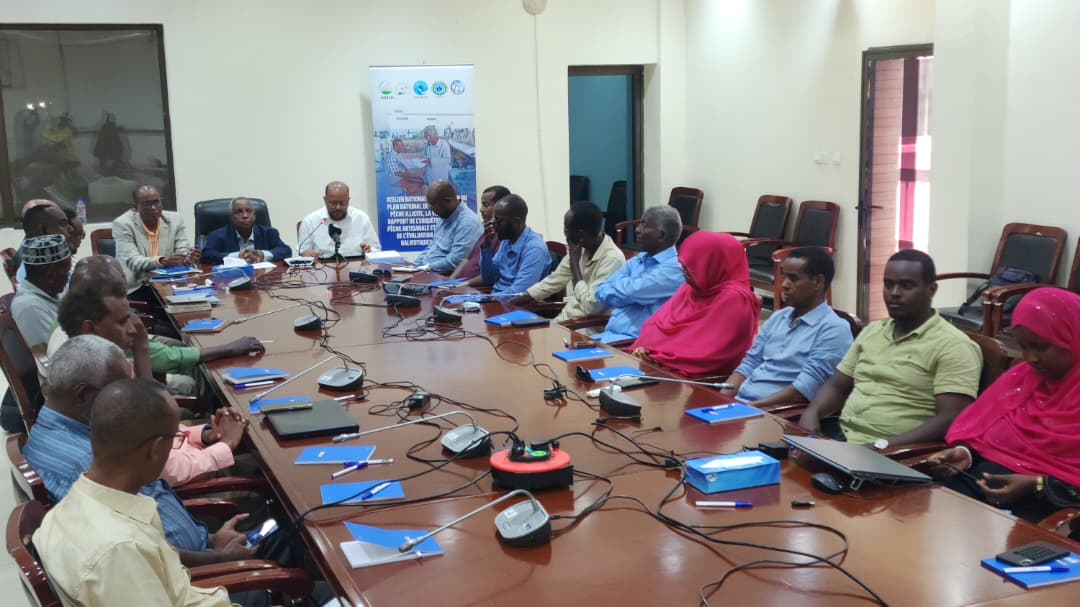
PERSGA, in collaboration with the Ministry of Environment and Sustainable Development of Djibouti, organized a national workshop on combating Illegal, Unreported and Unregulated (IUU) fishing, as well as on fisheries data and stock assessment. The workshop took place from 17 to 18 May 2026 at the People’s Palace in Djibouti, under the patronage of the the Ministry of Environment and Sustainable Development. The workshop form part of a regional efforts to advance sustainable fisheries in the PERSGA region under the SFISH I project financed by the World Bank.
The event brought together around 21 participants representing key national institutions, including the fisheries administration, the Ministry of Environment, fisheries cooperatives, research center (CERD), university of Djibouti, and the coast guards. The workshop was officially opened by the PERSGA representative and the Secretary General of the Ministry of Environment and sustainable Development. In their opening remarks, both highlighted the strategic importance of the Red Sea and Gulf of Aden region, which is globally recognized for its exceptional marine biodiversity and ecological value. The region hosts resilient coral reefs, extensive seagrass beds, and mangrove ecosystems that sustain fisheries productivity and support coastal livelihoods. The Red Sea is increasingly viewed as a potential climate refuge for coral reefs, while the Gulf of Aden is among the most biologically productive marine areas worldwide.
The first day of the workshop focused on regional and national efforts to advance sustainable fisheries management and to combat IUU fishing, through the SFISH I Project. Presentations highlighted ongoing SFISH project’s activities implementation led by PERSGA and implemented in all Member states to strengthen fisheries governance and enhance regional cooperation. A key session was dedicated to the introduction of Djibouti’s draft National Plan of Action to combat IUU fishing (NPOA-IUU). This plan, developed in alignment with the regional IUU strategy under the SFISH I Project, includes 54 priority actions aimed at improving monitoring, control, and surveillance systems, strengthening legal frameworks, and enhancing institutional coordination.
Participants engaged in detailed plenary discussions and group work to review the proposed actions, assess their feasibility, and ensure their relevance to national priorities. These exchanges provided valuable inputs for refining the plan and fostering a shared understanding among stakeholders.
The second day focused on strengthening the fisheries knowledge base through improved data systems. Presentations covered the results of the Fisheries Frame Survey and census, as well as fisheries statistics and stock assessment studies conducted in Djibouti between August 2024 and July 2025. These activities were carried out using standardized questionnaires and data collection tools developed jointly by PERSGA and the World Bank. The results provide an updated and comprehensive overview of fishing capacity, effort, and resource status, forming a critical foundation for evidence-based decision-making.
Discussions emphasized the importance of establishing sustainable data collection mechanisms, improving data quality and accessibility, and integrating scientific assessments into fisheries management processes. Participants also highlighted the need for continuous capacity building and institutional support to maintain and update fisheries information systems.
At the conclusion of the workshop, participants agreed on a set of key recommendations for follow-up actions, including:
- Finalizing and officially adopting the National Plan of Action to combat IUU fishing;
- Strengthening inter-agency coordination mechanisms for fisheries monitoring, control, and surveillance;
- Institutionalizing regular fisheries data collection and updating systems;
- Establish a MCS center for fisheries
- Enhancing technical capacities of national institutions in stock assessment and data analysis;
- Promoting awareness among fishing communities on sustainable fishing practices and compliance with regulations;
- Help in addressing ghost fishing and ALDFG
- Reinforcing collaboration with PERSGA and other relevant partners in the field of fishery sector.
At the conclusion of the workshop, participants expressed a high level of satisfaction with both the organization and technical delivery, acknowledging the strong contributions of the consultants and the project coordinators.